
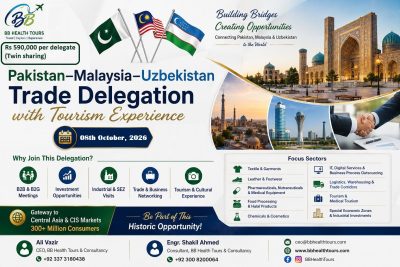
Brief Itinerary of Business Delegation from Pakistan (expected to be joined by Malaysian & South African business delegation as well)
Day 1: Thursday, 08th October, 2026 – Arrival, Tashkent Tourism & Pak Embassy dinner
- 05:20 a.m. – Morning: Depart from Karachi (KHI) to Tashkent International Airport (TAS).
- 08:20 a.m. Arrival at Tashkent Airport; Hotel check-in at Hotel
- Visit “AquaTherm HVACR Expo Uzbekistan” at UZ Expo Center, Tashkent. )
- Late Afternoon (Tourism) after lunch:
- Khast-Imam Complex: See the 7th-century Quran of Osman.
- Chorsu Bazaar: Experience vibrant, domed bazaar (great for dried fruits & bread).
- Tashkent Metro Tour: Ride the metro to see the stunningly decorated stations, often called “underground palaces” with Soviet-era mosaics and chandeliers.
- Evening: Welcome dinner with the Pakistani Embassy in Tashkent.
Day 2: Friday, 09th October – Sector Meetings (Tashkent)
- 09:00 – 12:00: Meetings with the Food Industry Association (Agri & Food) and local Cosmetics manufacturers/distributors.
- 13:00 – 14:00. Lunch Break:
- 14:00 – 16:00: Visit IT Park Uzbekistan and meet with the IT Park Association
- 16:30 – 18:00: Session at the Chamber of Commerce
- Dinner at a local restaurant. Night stay at the hotel in Tashkent.
Day 3: Saturday, 10th October – Samarkand Highlights (Day Trip)
- Early Morning: Transfer to Samarkand in mini-bus (320 kms in 6 hours.)
- Afternoon: Arrival in Samarkand; Lunch:
Samarkand Must-Sees – Attractions:
Registan Square – The crown jewel of Samarkand – three grand madrasahs with stunning blue tilework. The most iconic sight in all of Uzbekistan 1.5 hours
Gur-e-Amir Mausoleum – Burial vault of Timur (Tamerlane), with a breathtaking gold-leaf dome 45 minutes
Bibi-Khanym Mosque – One of the largest mosques in the Islamic world, built by Timur for his wife 45 minutes
Overnight stay in Samarkand hotel.
Day 4: Sunday, 11th October – Bukhara Highlights & Transfer to Navoi
Early Morning transfer to Bukhara (275 kms in 5 hours)
Afternoon: Arrival in Bukhara and Lunch:
Must-Sees – Attractions:
Kalon Minaret & Poi Kalon Square The 45-meter minaret that even Genghis Khan reportedly spared. The most iconic landmark in Bukhara 1 hour
Ark Fortress The oldest citadel in Bukhara, dating from the 1st century BC. Panoramic city views from the walls 1 hour
Lyabi Hauz Ensemble A 16th-17th century complex built around a central pool – the heart of old Bukhara, perfect for photos and atmosphere 45 minutes
Trading Domes (Toki Zargaron) Historic covered bazaars – ideal for buying silk, ceramics, and carpets 45 minutes
In the evening transfer to Navoi (115 kms in approx. 2 hours – sunset at 6:05 p.m.).
Night time, arrive in Navoi, lodge into your hotel. Dinner.
Day 5: Monday, 12th October – B2G & B2B Navoi Region Business Day
09:30 AM The delegation visits the Navoi Regional Administration (Khokimiyat) building.
10:30 AM Meeting with the Khokim (Governor), Courtesy meeting with Governor H.E. Mr. Normat Tursunov and senior officials to discuss the region’s economic potential.
11:30 AM Meeting with Investment Department A detailed presentation and Q&A session with the Chief Investment Officer. Key topics: tax incentives, customs duties, procedures in the Navoi Free Economic Zone (FEZ), and priority projects for foreign investors.
12:30 PM Business Lunch with the regional administration, providing an informal setting to network with local business leaders.
02:00 PM B2B Session / Site Visit (Optional) Depending on interest, either matchmaking meetings with local companies in textiles/chemicals or a visit to a relevant industrial site (e.g., Navoiyazot chemical plant or a textile park).
05:30 PM – Transfer to Samarkand (180 kms in 3h30 min).
09:00 PM – Arrive in Samarkand at your hotel after an intensive but productive day.
Day 6: Tuesday, 13th October – B2B, Transfer to Tashkent for Sector Meetings (Tashkent)
Early morning transfer to Tashkent (320 kms in 6 hours).
Afternoon: Arrival in Tashkent.
- Visit “Heimtextil Texworld & Apparel Sourcing Tashkent”; meeting with Uztekstilprom (Textile & Garment Association) and Uzcharmsanoat (Leather & Footwear Association).
- Meeting with the Chamber of Commerce and Industry of Uzbekistan and the Ministry of Investments, Industry & Trade to discuss the investment climate and incentives.
Back to Hotel for dinner. Overnight at Tashkent Hotel.
Day 7: Wednesday, 14th October – Final Meetings & Pack up (Tashkent)
- 09:30 – 11:00: (B2B): Uzkhimmaslahat (Chemicals sector Association) meeting.
- 11:00 – 12:30: Association of International Road Carriers (Logistics sector) meeting.
Afternoon: Lunch and then free time.
Evening: Formal Farewell Gala Dinner with Uzbek counterparts.
- 08: 30 p.m. Check-out and Depart for Tashkent International Airport
Day 8: Thursday, 15th October – Departure and Arrival in Karachi
00: 50 a.m. Night time departure from Tashkent Airport for Karachi with Centrum Air. Arrival in Karachi at 04:20 a.m.
**** End of tour ****
Costing:
The Price per delegate is Rs 590,000 on double room sharing basis (Rs 690,000 on single room basis)
The Price includes:
Return air-tickets (economy Centrum Air) 23 kgs check-in baggage; Uzbekistan Visa fee;
7 nights hotel stay in Tashkent, Samarkand and Navoi hotels (Wyndham or equivalent); Lunch and dinner; Transport in air-conditioned vehicle Hi-Ace/Coaster or equivalent;
The Price does not include:
Travel Insurance; Entry tickets to any of the places, Expo centers; Any item not specifically mentioned above.
What you will achieve with this business delegation tour!
08–15 October 2026 | Tashkent · Samarkand · Bukhara - Navoi
Tour Objectives
This 7-day trade mission is designed to connect Pakistani (and Malaysian) businesses with high-growth sectors in Uzbekistan. The delegation will benefit from:
- Direct B2B & B2G Meetings with government officials, investment authorities, industry associations and entrepreneurs.
- Site Visits to industrial zones, including the Navoi Free Economic Zone (FEZ).
- Exhibitions Participation at: a) Aquatherm HVACR (October 6-8); and b) Texworld & Apparel Sourcing Tashkent (October 12–14).
- Cultural & Historical Immersion in Uzbekistan’s UNESCO-listed cities.
Tourism & Cultural Highlights
| City | Key Attractions | What Participants Will Experience |
| Tashkent | Khast-Imam Complex (7th-century Quran), Chorsu Bazaar, Metro Tour | Islamic heritage, vibrant bazaar culture, Soviet-era architecture |
| Samarkand | Registan Square, Gur-e-Amir Mausoleum, Bibi-Khanym Mosque | The jewel of the Silk Road – stunning blue-tiled madrasahs and Timurid history |
| Bukhara | Kalon Minaret, Ark Fortress, Lyabi Hauz, Trading Domes | Ancient citadels, traditional tea houses, and historic trading domes for carpets & ceramics |
Cultural Takeaway: Participants will gain a deep appreciation of Uzbekistan’s rich Silk Road heritage, fostering stronger personal and business relationships with local counterparts.
Trade Connections & Sectoral Opportunities
| Sector | Key Partners / Institutions | Opportunities for Pakistani Businesses |
| Heating, Ventilation, Air Conditioning (HVAC) & Water Supply | Aquatherm Tashkent 2026 Exhibition, Uzexpocentre (Visit on our Day 1, Expo Day 3) | The only specialized HVAC and water supply exhibition in Uzbekistan. It provides a unique opportunity to connect with 192+ exhibitors from 12 countries. Pakistani manufacturers and suppliers can find distributors, establish new business connections, and assess the competitive landscape. |
| Textiles & Apparel | Heimtextil Texworld Expo – Uztekstilprom Association | JVs in garment manufacturing; export of Pakistani cotton yarn & finished goods; access to CIS markets |
| Leather & Footwear | Uzcharmsanoat Association | Collaboration in leather processing; technology transfer; export of Pakistani leather goods |
| Agri-Food | Food Industry Association | Halal food exports; dried fruits & nuts trade; joint processing facilities |
| Chemicals | Uzkhimmaslahat | Fertilizer imports (Navoiyazot); specialty chemicals; petrochemical partnerships |
| IT & Digital | IT Park Uzbekistan | Software outsourcing; fintech collaboration; cybersecurity solutions |
| Logistics | Association of International Road Carriers | Transit trade routes (Pakistan–Uzbekistan via Afghanistan); multimodal transport agreements |
| Investment | Navoi FEZ (Khokimiyat), Ministry of Investments | Tax incentives (0% corporate tax, customs duty exemptions); land allocation for manufacturing; 100% foreign ownership allowed |
Key Outcomes Expected
- Signed MOUs with the Chamber of Commerce and Industry of Uzbekistan.
- Concrete investment leads in the Navoi Free Economic Zone.
- Partnership agreements with Uzbek textile, leather, IT and food processing companies.
- Expanded market access for Pakistani goods into Central Asia and beyond.
- Stronger diplomatic & commercial ties between Pakistan and Uzbekistan.
Final Notes
- Gift Protocol: Delegates are encouraged to bring traditional Pakistani gifts (e.g., Sindhi Ajrak, carved onyx boxes, brass handicraft) for Uzbek officials.
- Weather: October offers mild, sunny weather (20–22°C) — ideal for business and tourism.
- Visa: Pakistani nationals are required visa & invitation letter for entry to Uzbekistan for up to 30 days.
For inquiries, please contact: Ali Vazir, CEO & Engr. Shakil Ahmed, Consultant
Delegation Leader +92 337 3180438; +92 300 8200064; ceo@bbhealthtours.com
🇵🇰 🇺🇿 PAKISTAN–UZBEKISTAN TRADE & TOURISM DELEGATION 2026
Strategic Sectors Potential Report
On the invitation of the Ministry of Investment of Uzbekistan and in collaboration with the Investment Department of Navoi Region and Centrum Air, BB Health Tours & Consultancy is pleased to announce a high-level Trade & Tourism Delegation to Uzbekistan, scheduled to depart from Karachi on 08th October 2026.
This unique delegation offers an exceptional opportunity to participate in:
✅ B2B Meetings (Business-to-Business)
✅ B2G Meetings (Business-to-Government)
✅ Investment Forums & Networking Sessions
✅ Visits to Special Economic Zones (SEZs)
✅ Industrial & Trade Site Visits
✅ Tourism & Cultural Experiences
The initiative builds upon the momentum generated by the recent visits of Mr. Normat Tursunov, Governor of Navoi Region, and H.E. Mr. Alisher Tukhtaev, Ambassador of Uzbekistan to Pakistan, to Karachi during April and May 2026.
Priority Sectors:
• Textile & Garments
• Leather & Footwear
• Pharmaceuticals, Nutraceuticals & Medical Equipment
• Food Processing & Halal Products
• Chemicals & Cosmetics
• IT, Digital Services & Business Process Outsourcing (BPO)
• Logistics, Warehousing & Trade Corridors
• Tourism, Religious & Medical Tourism
• Special Economic Zones & Industrial Investments
|
PAKISTAN’S TRADE WITH UZBEKISTAN (MILLION US$) |
||||||||
| YEAR | EXPORTS | IMPORTS | TOTAL TRADE | BALANCE OF TRADE | TOTAL EXPORT OF PAK | % SHARE IN TOTAL EXPORT | TOTAL IMPORTS OF PAK | % SHARE IN TOTAL IMPORT |
| 2020 | 24 | 97.4 | 121.4 | -73.3 | 22,247.5 | 0.1 | 45,841.7 | 0.2 |
| 2021 | 50.7 | 126.6 | 177.3 | -75.9 | 28,880.0 | 0.2 | 73,106.6 | 0.2 |
| 2022 | 110.8 | 123.7 | 234.5 | -12.9 | 31,175.9 | 0.4 | 71,104.7 | 0.2 |
| 2023 | 73.4 | 30.5 | 103.9 | 42.9 | 28,491.0 | 0.3 | 50,535.0 | 0.1 |
| 2024 | 103.7 | 257.3 | 361.0 | -153.6 | 30,600.0 | 0.3 | 54,800.0 | 0.5 |
| 2025 | 106.2 | 32.2 | 138.4 | 74.0 | 30,760.0 | 0.3 | 65,170.0 | 0.05 |
MAJOR ITEMS OF EXPORTS FROM PAKISTAN TO UZBEKISTAN (Million $)
| Specific Commodity Description | 2022 | 2023 | 2024 | 2025 | |
| 1 | Edible vegetables and certain roots and tubers | 40.2 | 19.8 | 4.4 | |
| 2 | Pharmaceutical products | 26.3 | 40 | 56.7 | 23.5 |
| 3 | Edible fruit and nuts; peel of citrus fruit or melons | 8.3 | 39.5 | 0.9 | |
| 4 | Meat and edible meat offal | 7.3 | 21.8 | 14.6 | |
| 5 | Soap, organic surfaceactive agents, washing preparations, lubricating preparations, artificial | 5.9 | 7 | 8.1 | 3.9 |
| 6 | Sugars and sugar confectionery | 5.4 | |||
| 7 | Aluminium and articles thereof | 4.8 | 3 | 6.3 | 5.1 |
| 8 | Inorganic chemicals; organic or inorganic compounds of precious metals, of rare-earth metals | 2.6 | |||
| 9 | Cereals, mostly Rice | 1.5 | 8 | 3.9 + 20.5 (Rice) | 4 + 38.6 (Rice) |
| 10 | Miscellaneous edible preparations | 1.1 | |||
| 11 | Potatoes | 15 | |||
| 12 | Textile Products | 5 | |||
| 13 | Sesame Seeds | 3 | |||
| 14 | Machinery & Equipment | 2 | 3.8 | ||
| 15 | Surgical & Medical Prod | 1 | |||
| 16 | Chemicals | 1 | |||
| 17 | Cotton | 9.3 | 1.1 | ||
| 18 | Oil Seeds & Seeds | 4.4 | |||
| 19 | Sports Goods | 1.6 |
MAJOR ITEMS OF IMPORTS IN PAKISTAN FROM UZBEKISTAN (Million $)
| S# | ITEM | 2022 | 2023 | 2024 | 2025 |
| 1 | Edible vegetables and certain roots and tubers (mainly onion & dried onion) | 91.1 | 150 | 20.3 | 23.6 |
| 2 | Cotton | 14.1 | 60 | ||
| 3 | Cereals & Wheat | 6.6 | 30 | 2 | 1.1 |
| 4 | Salt; sulphur; earths and stone; plastering materials, lime and cement | 6.2 | 2 | 2 | 3.3 |
| 5 | Oil seeds and oleaginous fruits; miscellaneous grains, seeds and fruit; industrial or medicinal | 1.9 | 8 | 0.3 | |
| 6 | Mineral fuels, mineral oils and products of their distillation; bituminous substances; mineral | 1.8 | |||
| 7 | Edible fruit and nuts; peel of citrus fruit or melons | 1.5 | 0.8 | ||
| 8 | Machinery and mechanical appliances; parts thereof | 0.3 | 0.3 | ||
| 9 | Ceramic Products | 0.1 | |||
| 10 | Other made-up textile articles; sets; worn clothing and worn textile articles; rags | 0.0 | |||
| 11 | Silk | 0.7 | 0.1 | ||
| 12 | Fertilizers | 0.6 | 0.7 | 0.7 | |
| 13 | Leather & Raw hides | 0.5 | 0.1 | 0.1 | |
| 14 | Cotton & Cotton Fiber | 5 | 2.6 | ||
| 15 | Copper & Zinc products | 0.3 | 0.4 | ||
| 16 | Mineral Fuels | 0.1 |
Observations:
The 2025 figures reveal that Pakistan’s exports to Uzbekistan are becoming increasingly concentrated in:
- Food & Agriculture (Rice, Meat, Vegetables)
- Pharmaceuticals
- Consumer Products (Soaps)
- Aluminum Products
- Sports Goods
Meanwhile, Pakistan’s imports from Uzbekistan are dominated by:
- Onions and vegetables
- Cotton
- Minerals
- Agricultural inputs
Future Opportunities (2026–2030):
- Textile & Garments
- Leather & Footwear
- Pharmaceuticals Manufacturing
- Halal Food Processing
- Palm Downstream Products (Malaysia)
- Logistics & Trade Corridors
- IT & BPO
- Tourism & Medical Tourism
- Special Economic Zones
Introduction
Uzbekistan, with a population exceeding 37 million and strategically located at the heart of Central Asia, is rapidly emerging as one of the region’s most attractive investment destinations. The country serves as a gateway to the wider Central Asian and CIS markets comprising over 300 million consumers across Kazakhstan, Kyrgyzstan, Tajikistan, Turkmenistan, Russia, Belarus, Armenia, and neighboring Eurasian economies.
Under ongoing economic reforms, Uzbekistan has actively encouraged foreign direct investment through industrial zones, infrastructure development, trade facilitation, and business-friendly policies. For Pakistani and Malaysian businesses, Uzbekistan offers a unique opportunity to establish manufacturing, distribution, logistics, and service hubs for the wider region.
Uzbekistan attracted a Foreign Direct Investment of $43.1 billion in 2025, representing a 24% increase over 2024. Major sectors: Manufacturing, Energy (Solar, Wind, Gas), Mining & Metallurgy, Chemicals & Petrochemicals, Pharmaceuticals, Logistics & Transport, Agri & Food Processing, Infrastructure & construction, Information Technology, Tourism & Hospitality.
Strategic Sectors of Uzbekistan (10)
- Textile & Garments
Pakistan is among the world’s leading producers of cotton yarn, fabrics, home textiles, denim, knitwear, and garments. Uzbekistan is itself a major cotton-producing nation and has been actively developing its textile value chain.
Opportunities for Pakistani Businesses
- Joint ventures in textile processing, garment manufacturing, and textile finishing.
- Establishment of regional distribution centers for Central Asian and CIS markets.
- Export of Pakistani fabrics, denim, towels, and value-added garments.
- Collaboration in technical textiles and textile machinery.
Why Uzbekistan?
- Abundant cotton production.
- Competitive labor costs.
- Modern industrial parks and free economic zones.
- Access to Central Asian and Eurasian markets.
Additional Opportunities for Malaysian Businesses
- Supply of textile chemicals, dyes, machinery, and automation solutions.
- Investment in sustainable textile manufacturing and green technologies.
- Leather, Footwear & Sports Goods
Pakistan enjoys a strong international reputation in leather garments, gloves, footwear, sports goods, and leather accessories.
Opportunities for Pakistani Businesses
- Leather finishing and value-addition facilities.
- Safety gloves and industrial protective equipment manufacturing.
- Sports goods production and distribution for regional markets.
- Joint ventures in footwear manufacturing.
Why Uzbekistan?
- Growing consumer markets in Central Asia.
- Access to raw hides and leather processing opportunities.
- Strategic location for exports to CIS countries.
Additional Opportunities for Malaysian Businesses
- Supply chain management and retail branding expertise.
- Investment in modern footwear and leather manufacturing technologies.
- Pharmaceuticals, Nutraceuticals & Medical Equipment
Pakistan’s pharmaceutical sector has developed significant manufacturing capacity in generic medicines and healthcare products.
Opportunities for Pakistani Businesses
- Pharmaceutical manufacturing and packaging.
- Surgical instruments and medical disposables.
- Nutraceuticals and herbal products.
- Hospital management and healthcare consultancy.
Why Uzbekistan?
- Expanding healthcare infrastructure.
- Increasing demand for affordable medicines.
- Potential for regional pharmaceutical distribution hubs.
Additional Opportunities for Malaysian Businesses
- Halal-certified pharmaceuticals.
- Healthcare technology, medical devices, and wellness products.
- Food Processing, Halal Products & Agriculture
Agriculture remains a major pillar of Uzbekistan’s economy.
Opportunities for Pakistani Businesses
- Rice, meat, spices, processed foods, and confectionery exports.
- Halal certification partnerships.
- Food processing and packaging investments.
- Dairy and livestock collaboration.
Why Uzbekistan?
- Strong agricultural base.
- Growing food processing industry.
- Demand for halal-certified products in Central Asia.
Additional Opportunities for Malaysian Businesses
- Palm oil and palm downstream products.
- Food ingredients, flavorings, and food technology solutions.
- Halal industry expertise and certification systems.
- Chemicals, Cosmetics & Consumer Products
Consumer demand for personal care and industrial chemical products is increasing throughout Central Asia.
Opportunities for Pakistani Businesses
- Soaps, detergents, cosmetics, and household products.
- Industrial chemicals and packaging materials.
- Personal care product manufacturing partnerships.
Why Uzbekistan?
- Growing middle-class consumer market.
- Increasing retail sector development.
Additional Opportunities for Malaysian Businesses
- Oleochemical products derived from palm oil.
- Cosmetic ingredients and beauty industry technologies.
- Logistics, Warehousing & Trade Corridors
This may be the most strategic area for trilateral cooperation.
Opportunities for Pakistani Businesses
- Development of trade corridors linking Central Asia with Pakistani seaports.
- Warehousing, freight forwarding, and logistics services.
- Transit trade facilitation through Karachi, Port Qasim, and Gwadar.
Why Uzbekistan?
- Central location in Eurasia.
- Growing transport and logistics infrastructure.
- Strong government focus on regional connectivity.
Additional Opportunities for Malaysian Businesses
- Utilizing Pakistan-Uzbekistan connectivity to access CIS markets.
- Establishment of regional distribution and sourcing hubs.
Long-Term Vision
Malaysia → Pakistan Ports → Uzbekistan → Central Asia & CIS Markets
- Information Technology, Digital Services & BPO
Pakistan has become one of the fastest-growing IT and freelancing markets globally.
Opportunities for Pakistani Businesses
- Software development and outsourcing services.
- FinTech and digital payment solutions.
- Artificial Intelligence and business automation.
- E-commerce platforms and support services.
Why Uzbekistan?
- Digitization initiatives by the government.
- Young and increasingly tech-savvy workforce.
- Expanding technology parks and innovation centers.
Additional Opportunities for Malaysian Businesses
- Technology transfer and startup investments.
- Regional digital services and smart-city solutions.
- Construction Materials & Infrastructure
Large-scale development projects are underway across Uzbekistan.
Opportunities for Pakistani Businesses
- Cement, ceramics, sanitary ware, and construction materials.
- Engineering consultancy and project management.
- Building materials distribution.
Why Uzbekistan?
- Rapid urbanization and industrial development.
- Continued investment in infrastructure projects.
Additional Opportunities for Malaysian Businesses
- Smart infrastructure technologies.
- Green building and sustainable construction solutions.
- Tourism, Religious Tourism & Medical Tourism
Uzbekistan is one of the most fascinating destinations on the historic Silk Road.
Opportunities for Pakistani Businesses
- Tourism promotion and destination management.
- Medical tourism facilitation.
- Wellness, rehabilitation, and healthcare tourism.
- Religious and cultural tourism packages.
Why Uzbekistan?
- World-renowned destinations including Tashkent, Samarkand, Bukhara, Khiva, and the Fergana Valley.
- Strong government support for tourism development.
- Growing international visitor arrivals.
Additional Opportunities for Malaysian Businesses
- Tourism marketing partnerships.
- Halal tourism, hospitality management, and wellness tourism expertise.
- Free Economic Zones (FEZs) & Industrial Parks
Uzbekistan has established numerous Free Economic Zones and Industrial Parks to attract foreign investment.
Opportunities for Pakistani Businesses
- Establishment of manufacturing and assembly units.
- Regional warehousing and distribution centers.
- Export-oriented industrial investments.
Why Uzbekistan?
- Investment incentives and industrial infrastructure.
- Access to regional markets.
- Government support for foreign investors.
Additional Opportunities for Malaysian Businesses
- Manufacturing partnerships targeting Central Asia.
- Participation in industrial park development and management.
Conclusion
The proposed Pakistan–Malaysia Trade & Tourism Delegation to Uzbekistan presents a unique opportunity to connect three dynamic regions: South Asia, Central Asia, and ASEAN. By leveraging Pakistan’s manufacturing capabilities and strategic ports, Uzbekistan’s geographic position and growing economy, and Malaysia’s industrial expertise and global trade networks, significant opportunities can be created in trade, investment, logistics, tourism, and industrial cooperation.
The delegation will not only explore business opportunities in Tashkent, Samarkand, Bukhara, and other regions of Uzbekistan, but will also help establish long-term partnerships that can serve the wider Central Asian and CIS markets for years to come.
* * * * * * * *